Wednesday, June 18, 2014
A Didi Mini Goes Cruising
The first boat to our Didi Mini design, drawn to the Mini 650 Rule, was built by CKD Boats of Cape Town for owner Mike O'Neill. She was named "Warlock" and never raced in anger. Mike is a superyacht captain and seldom in the same location as his little boat. Eventually he sold her and the new owner commissioned Fluid Yachts, based in the gorgeous town of Knysna, to transform her into a little fast cruiser. The photos below show "Warlock" in her original form and the transformed "iCandy".
Changes include a reworked interior with as many comforts as could be fitted into such a small hull, extension of the deck to the transom, swept-spreader rig for easier handling and a retro-fitted lifting keel to replace the 2m deep fixed keel.
Read More..
Changes include a reworked interior with as many comforts as could be fitted into such a small hull, extension of the deck to the transom, swept-spreader rig for easier handling and a retro-fitted lifting keel to replace the 2m deep fixed keel.
 |
| "Warlock" with 2m fixed keel |
 |
| "Warlock" had the old style Mk1 aft deck. |
 |
| "iCandy" with lifting keel to access shallower anchorages. |
 |
| "iCandy" with extended aft deck for a bigger cockpit. |
 |
| "iCandy" with tall swept-spreader rig for easier control. |
 |
| "iCandy" now has a retro-fitted aluminium lifting keel. |
 |
| Keel-lifting tackle of "iCandy". |
 |
| Looking aft from the massive forward double berth into the saloon. |
The new lifting keel of "iCandy" is to our design and can be retro-fitted to any of the Didi Mini or Didi Cruise-Mini series designs. Keel-down draft is 2m, the same as the fixed keel, but it can lift to reduce draft to 1m, for access to shallow moorings or anchorages.
For more about our Didi Mini design series or our other designs, please visit our main website at http://dixdesign.com/ .

Saturday, June 7, 2014
Argie 15 - A Boat with Multiple Personalities
The Argie 15 is our most popular design, with about 50 plans sold to builders worldwide every year. I designed it in 1988 for the Argus newspaper group in South Africa, for publication of the full plans in their newspapers around the country. The prototype was built by journalist David Biggs, who wrote their weekly DIY supplement, in which the drawings were first published. It has also been published in magazines in Australia and USA, with amateurs able to build from the articles. We can only record plan sales and have no idea how many have been built from those publications.
The Argie 15 started life as a large 3:1 dinghy, able to be rowed, sailed or motored. The design brief was for as large a dinghy as could be built from 6 sheets of plywood. To that I added the ability to be used for camp-cruising, so I laid out the cockpit to give enough length and width for two adults to sleep on air mattresses in the cockpit, under a boom tent.
Over the years that followed, many builders added side seats to make it more comfortable to sail than was possible with the thwart-type seating of the original design. Eventually I added information to the drawings for building with full-length side seats, which added another two sheets of plywood. These also increase safety for sailing in rougher water by reducing splash water entering the cockpit and adding flotation. For camp-cruising, the seats add watertight stowage compartments for clothing and food.
The Argie 15 has proven to be a very versatile boat, well beyond the scope of the original design. It was intended as a large open boat for family fun but has proven capable of so much more.
The late Colin Farlam, a larger-than-life character around the yacht clubs of Cape Town, liked to tell the story of his first sail in an Argie 15. He was visiting a friend at Zeekoevlei, the lake where I grew up and did most of my small boat sailing. The Zeekoevlei Yacht Club fleet was on the water, racing in quite strong conditions. There was an Argie 15 on the lawn and the friend said "Come, lets go race the Fireballs". Colin's response was "We can't race them in that". They did "race them in that" and Colin was shocked. He told me that they could hold the Fireballs on all headings except that they sailed a fraction lower to windward. Not bad for a 3:1 family dinghy. But this 3:1 family dinghy can pick up it's skirts and fly like no 3:1 family dinghy is supposed to do. Colin immediately bought one for himself and later declared to me that the Argie 15 was the best dinghy that he had ever sailed.
The Argie 15 has classic styling, with a springy sheer and good freeboard. That makes it a dry boat in lumpy water and well-suited to fishing in moderate coastal conditions. This was the plan of Pete Frielinnghaus when he fitted a centre console and 30hp outboard to his Argie 15. He reports that it can do more than 20 knots. Pretty good for a 3:1 family dinghy.
After the 2004 tsunami, I was approached by a church organisation from California, asking if I had a design that could be used to help replace the decimated subsistence fishing fleets. I donated the Argie 15 design for as many boats as they needed to build. They cut plywood component kits and supplied the kits plus all other materials needed, as well as training, to allow fishermen to build the boats on the beach in India. I have no idea how many were built this way.
The Argie 15 would be a great boat for raid-type adventure sailing events. It has the load capacity to carry the crew plus stores, camping gear etc. It is fast enough to get there ahead of most of the competition. It is light enough to be portaged over short distances or trailed on a dolly for longer overland legs.
I have been promising myself for years that I will build an Argie 15 for myself. Somehow there has always been some other project or adventure in the way, so it hasn't happened. This would be a good boat to take to the Wooden Boat Show at Mystic Seaport. I must pull finger and build one to take to the show in the next year or two.
Construction is the most basic of basic boatbuilding methods, stitch-&-glue plywood. It uses 6mm plywood that is jointed mostly with fibreglass tape and resin. This method sometimes produces rather boxy shapes but the Argie 15 manages to be quite elegant. It can be built from plans only, with components drawn full-size from dimensioned diagrams on the drawings. An optional extra is to order full-size patterns that save the measuring work by supplying printed patterns of the components, for the builder to transfer onto the plywood.
Pre-cut kits of all plywood components are also available from suppliers in a few countries. Our USA kits are cut and shipped by Chesapeake Light Craft in Annapolis but must be ordered from us direct. For suppliers in other countries go to our kits page.
There are many sailing videos on-line of the Argie 15. A new one by Justin Philips of Nick Fairley's new Argie 15 sailing in about 12 knots of breeze, shows how responsive and quick it is, tacking on a tickey and accelerating very quickly out of turns. http://youtu.be/gNFx8FHGiww
To see our full range of designs, please visit http://dixdesign.com/ .
Read More..
 |
| Newly launched Argie 15 prototype, Dudley at helm. |
Over the years that followed, many builders added side seats to make it more comfortable to sail than was possible with the thwart-type seating of the original design. Eventually I added information to the drawings for building with full-length side seats, which added another two sheets of plywood. These also increase safety for sailing in rougher water by reducing splash water entering the cockpit and adding flotation. For camp-cruising, the seats add watertight stowage compartments for clothing and food.
The Argie 15 has proven to be a very versatile boat, well beyond the scope of the original design. It was intended as a large open boat for family fun but has proven capable of so much more.
 |
| This photo of Nick Fairley's boat shows the capacity of the Argie 15 pretty well. |
The Argie 15 has classic styling, with a springy sheer and good freeboard. That makes it a dry boat in lumpy water and well-suited to fishing in moderate coastal conditions. This was the plan of Pete Frielinnghaus when he fitted a centre console and 30hp outboard to his Argie 15. He reports that it can do more than 20 knots. Pretty good for a 3:1 family dinghy.
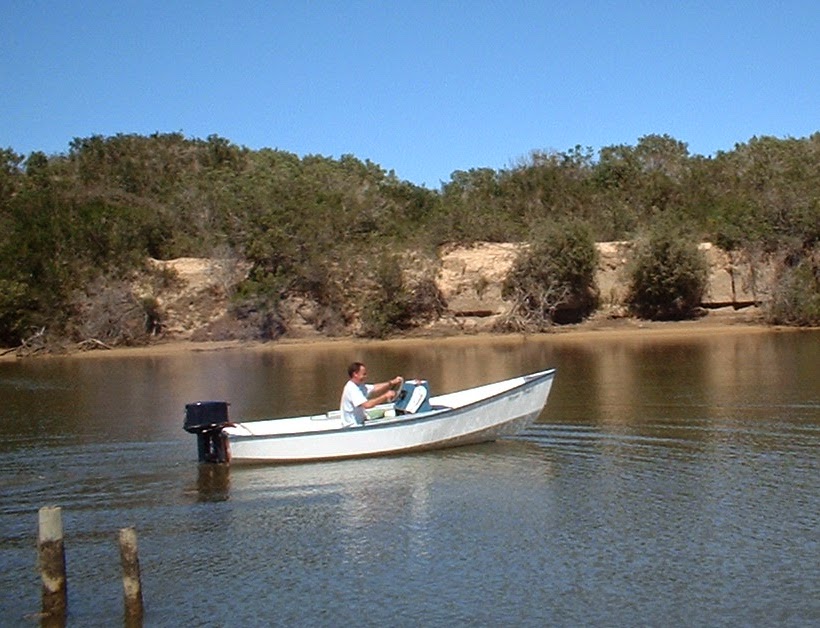 |
| Pete Frielinghaus in his Argie 15 centre console fishing boat. |
The Argie 15 would be a great boat for raid-type adventure sailing events. It has the load capacity to carry the crew plus stores, camping gear etc. It is fast enough to get there ahead of most of the competition. It is light enough to be portaged over short distances or trailed on a dolly for longer overland legs.
I have been promising myself for years that I will build an Argie 15 for myself. Somehow there has always been some other project or adventure in the way, so it hasn't happened. This would be a good boat to take to the Wooden Boat Show at Mystic Seaport. I must pull finger and build one to take to the show in the next year or two.
Construction is the most basic of basic boatbuilding methods, stitch-&-glue plywood. It uses 6mm plywood that is jointed mostly with fibreglass tape and resin. This method sometimes produces rather boxy shapes but the Argie 15 manages to be quite elegant. It can be built from plans only, with components drawn full-size from dimensioned diagrams on the drawings. An optional extra is to order full-size patterns that save the measuring work by supplying printed patterns of the components, for the builder to transfer onto the plywood.
Pre-cut kits of all plywood components are also available from suppliers in a few countries. Our USA kits are cut and shipped by Chesapeake Light Craft in Annapolis but must be ordered from us direct. For suppliers in other countries go to our kits page.
There are many sailing videos on-line of the Argie 15. A new one by Justin Philips of Nick Fairley's new Argie 15 sailing in about 12 knots of breeze, shows how responsive and quick it is, tacking on a tickey and accelerating very quickly out of turns. http://youtu.be/gNFx8FHGiww
To see our full range of designs, please visit http://dixdesign.com/ .
Tuesday, May 20, 2014
Search for Missing Yacht in North Atlantic
Last week a 12m yacht, the "Cheeki Rafiki", sailing from Caribbean to UK, started taking on water in mid-Atlantic. They were obviously in a serious situation and contact with the yacht was lost early hours of Friday when about 600 miles off Cape Cod, Massachusetts. A search was started by the United States Coast Guard and the upturned hull of a sailboat was spotted by a tanker crew that reported it but did not investigate further. The search was called off by USCG on Sunday, about 48 hours after the search started.
The USCG press release said "We appreciate the assistance of the U.S. Air Force, Canadian and the three merchant vessels helping us to conduct a thorough search so far from shore," said Capt. Anthony Popiel, 1st Coast Guard District chief of response. "We are extremely disappointed that we were not able to locate the sailors during the course of this extensive search. Our thoughts and prayers are with their families during this difficult time."
There followed a huge outcry against calling off the search so soon and it has been resumed today. This was after many thousands of people signed petitions calling on the USCG to resume the search and many private yacht owners vowed to go out there in their own boats to search if the USCG would not do it.
I have some questions.
1) Isn't it a primary function of the USCG to go out there and search for whoever is missing or in trouble? This is a department of US government, paid for by the people. Is it that strapped for cash that it can't search longer than 48 hours for four people who are in dire straits, when they have a pretty good idea of where they are?
2) We have watched with fascination how carefully the Southern Indian Ocean has been searched for a missing aircraft. I accept that searching for a missing yacht or liferaft with four people aboard can't be compared with a search for a plane with hundreds. But they know where this boat is, it was even seen from a ship. They are not guessing or relying on foggy evidence to locate a start point for the search. The boat is there and it is/was afloat. If the crew abandoned ship into the liferaft, as seems the most likely scenario, the raft is likely to be downwind or downcurrent, or a combination of the two, of the position of the abandoned yacht. Why would the USCG assume that the crew were in the water and unable to survive when they had a liferaft available for just such an emergency? People have survived for many months in liferafts, surviving tumultuous storms and everything else that nature has thrown at them before eventually being found.
3) Isn't it maritime law that seamen are required to assist each other when in distress? A report in Metro News says that "the overturned hull of the boat was spotted by a passing tanker shortly after they disappeared but it was not inspected as there was no sign of the crew". People have survived in capsized or even sunken boats for considerable time, about two weeks in the most recent case. Why would the captain of the ship not stop his vessel and investigate. He saw the capsized boat. Unless it was storm conditions he should have been able to launch a boat to cross to the yacht. Banging on the hull and listening for a response would have told them if anyone was alive inside. Seeing it, reporting it and moving on did nothing to assist the crew aside from recording a start point for the search. Is commercial profit so important to the ship's owners that they would not do everything in their power to ascertain that there was nobody there to rescue?
Thanks for reading my rant.
Read More..
The USCG press release said "We appreciate the assistance of the U.S. Air Force, Canadian and the three merchant vessels helping us to conduct a thorough search so far from shore," said Capt. Anthony Popiel, 1st Coast Guard District chief of response. "We are extremely disappointed that we were not able to locate the sailors during the course of this extensive search. Our thoughts and prayers are with their families during this difficult time."
There followed a huge outcry against calling off the search so soon and it has been resumed today. This was after many thousands of people signed petitions calling on the USCG to resume the search and many private yacht owners vowed to go out there in their own boats to search if the USCG would not do it.
I have some questions.
1) Isn't it a primary function of the USCG to go out there and search for whoever is missing or in trouble? This is a department of US government, paid for by the people. Is it that strapped for cash that it can't search longer than 48 hours for four people who are in dire straits, when they have a pretty good idea of where they are?
2) We have watched with fascination how carefully the Southern Indian Ocean has been searched for a missing aircraft. I accept that searching for a missing yacht or liferaft with four people aboard can't be compared with a search for a plane with hundreds. But they know where this boat is, it was even seen from a ship. They are not guessing or relying on foggy evidence to locate a start point for the search. The boat is there and it is/was afloat. If the crew abandoned ship into the liferaft, as seems the most likely scenario, the raft is likely to be downwind or downcurrent, or a combination of the two, of the position of the abandoned yacht. Why would the USCG assume that the crew were in the water and unable to survive when they had a liferaft available for just such an emergency? People have survived for many months in liferafts, surviving tumultuous storms and everything else that nature has thrown at them before eventually being found.
3) Isn't it maritime law that seamen are required to assist each other when in distress? A report in Metro News says that "the overturned hull of the boat was spotted by a passing tanker shortly after they disappeared but it was not inspected as there was no sign of the crew". People have survived in capsized or even sunken boats for considerable time, about two weeks in the most recent case. Why would the captain of the ship not stop his vessel and investigate. He saw the capsized boat. Unless it was storm conditions he should have been able to launch a boat to cross to the yacht. Banging on the hull and listening for a response would have told them if anyone was alive inside. Seeing it, reporting it and moving on did nothing to assist the crew aside from recording a start point for the search. Is commercial profit so important to the ship's owners that they would not do everything in their power to ascertain that there was nobody there to rescue?
Thanks for reading my rant.
Thursday, May 15, 2014
Capsizing Big Sailboats
The article about our January capsize in the Cape to Rio Race is now in print in Professional Boatbuilder magazine. It is also available in digital form to print subscribers. This publication is free but is only available to members of the boating industry. Click to see the contents of the current issue.
In retrospect, the thing that amazes me most about this event is this. I was upright, walking through the boat at the time, heading for the cockpit. I was unaware that we were being capsized until the cabin roof hit the water at the bottom of the wave, with the boat well rotated toward upside-down. It happened very fast, with the boat moving through an arc that must have applied large centrifugal forces, enough for me to be well past horizontal and still walking on the cabin sole. Everything else in the boat stayed in place through that process as well, only becoming dislodged when we impacted the bottom of the wave.
Those who don't have access to the magazine can read about our capsize in my January posts on this blog.
Visit our website at http://dixdesign.com/.
Read More..
 |
| Graphic from Professional Boatbuilder magazine of the start of the capsize. |
Those who don't have access to the magazine can read about our capsize in my January posts on this blog.
Visit our website at http://dixdesign.com/.
Tuesday, May 13, 2014
Paper Jet to Okoumefest
Every year in May Chesapeake Light Craft hosts a demo day on Kent Island, in northern Chesapeake Bay. This is to give potential home builders the opportunity to test the various boats ahead of buying a kit. CLC cut the CNC kits for our plywood boats in USA, so we join the happy day of boating on the beach.
We had a two Paper Jets there last year and I will have my own yellow prototype, PJ #1, there again this year. Those who want to test sail her, please join us on the beach at Matapeake State Park, between 9am and 5pm.
Paper Jet sail numbers are now up to 84 and growing. This is a fun boat to sail. Come along to Okoumefest to see and sail her for yourself.
To see more about this design and the others in our wide range, please visit http://dixdesign.com/.
Read More..
We had a two Paper Jets there last year and I will have my own yellow prototype, PJ #1, there again this year. Those who want to test sail her, please join us on the beach at Matapeake State Park, between 9am and 5pm.
 |
| Dudley preparing PJ #007 for sailing, Okoumefest 2013. |
 |
| PJ #007 returning from a test sail, Okoumefest 2013. |
 | |
| PJ #001 patiently waits on the beach for her turn to be rigged. Okoumefest 2013. |
To see more about this design and the others in our wide range, please visit http://dixdesign.com/.
Saturday, May 10, 2014
Didi Mini Mk3 Kit from CKD Boats
I would have to dig deep in my files to find when CKD Boats first started cutting kits to our plywood designs. Owned by Roy McBride, this Cape Town company has the longest history of cutting our kits and has shipped kits for our plywood boats to many countries around the world. They also have the most experience with packaging large or small kits securely enough to arrive at their destination without damage or loss.
The most remote was a Didi 38 kit sent to Johnston Atoll in the North Pacific. It was a very comprehensive kit that included all plywood, complete rig, keel, engine, sterngear, galley equipment, deck hardware, pulpits, sails and even pre-cut window panels and all the cushions pre-upholstered. This was all packed into a standard 20ft container and had to be shipped via New Zealand and Hawaii, all expertly managed by Roy, his staff and his subcontractors.
CKD Boats has just completed cutting a kit for the Didi Mini Mk3 for a customer in France. It will be packed next week for shipping.
The plywood components are held in place in the sheets by thin tabs that are left between the full-depth cuts. They are released from the sheets by cutting through the tabs with a box-cutter or jigsaw. This system keeps the plywood as full 8x4 sheets for easy packaging and protection of the components from loss or damage.
The Didi Mini Mk3 is one of the first boats that I converted to jigsaw joints instead of the stepped scarph joints that we used previously. This results in easier assembly and is easier to cut, with less machine time involved. These two panels both show a narrow cut on one side and a wide cut on the other. The wide cut is at the junction between flat and radiused panels, so it has a half-depth rebate pre-cut full length of the panel for the structural joint of the radius panel to the flat sheet.
When this kit is out of the shop, the next will start cutting. This is for a Didi Sport 15 to fill an order from a South African builder.
To see these designs and others in our very broad range, please visit http://dixdesign.com/.
Read More..
The most remote was a Didi 38 kit sent to Johnston Atoll in the North Pacific. It was a very comprehensive kit that included all plywood, complete rig, keel, engine, sterngear, galley equipment, deck hardware, pulpits, sails and even pre-cut window panels and all the cushions pre-upholstered. This was all packed into a standard 20ft container and had to be shipped via New Zealand and Hawaii, all expertly managed by Roy, his staff and his subcontractors.
CKD Boats has just completed cutting a kit for the Didi Mini Mk3 for a customer in France. It will be packed next week for shipping.
 |
| Didi Mini Mk3 sheet fresh from the CNC router. |
 |
| Didi Mini Mk3 hull skin panels with jigsaw joints. |
When this kit is out of the shop, the next will start cutting. This is for a Didi Sport 15 to fill an order from a South African builder.
To see these designs and others in our very broad range, please visit http://dixdesign.com/.
Thursday, May 1, 2014
Didi 950 Radius & Clean Workshops
Mike Vermeersch has completed the first layer of the radius panel on one side of his Didi 950 hull. Although the surface is not up to final level, the hull shape is now much clearer.
In theses photos the radius skin has still to be trimmed back to hull centreline. When that is done, the shape of the forefoot as it fairs into the bow will become clear.
Thanks to Mike for these great photos. A few people have commented about the cleanliness of Mike's project and also of his workshop. I like to work clean on my boatbuilding projects but Mike takes it to a whole new level. That might be due to his engineering background.
The benefits of working this way are many. A very important one is that it is much easier to clean up runs and drips of excess glue etc before it cures than to do it later. If a lump or run of epoxy or resorcinol is allowed to cure, it will be stronger than the surface of the wood and will rip out pieces of wood while you remove it with a chisel. You also need to thump the head of the chisel with a mallet or at least your hand, to move it along. Expect occasional bruising of the palm of your hand in the process. You can grind or sand it off mechanically but that is always with a risk of damaging the surface and the equipment cannot generally get into tight corners. You can more easily remove it with a slightly blunt chisel or a scraper soon after it reaches initial cure, without risk of surface damage. Resorcinol is really nice in this way because it becomes rubbery and can be easily and very cleanly sliced off. Epoxy will drag on the tool and not trim off as cleanly, so the natural tendency is to leave it for later when it is hard.
The other major benefits of a clean workshop are that it is just so much nicer to work in a clean environment and you are less likely to hurt yourself by standing on odd-shaped bits of wood, slipping on wood shavings or gluing your shoes to the floor. I generally sweep the work area about every 2nd day or more often if I am doing something that produces lots of dust or waste.
Please visit our website at http://dixdesign.com/ to see our very broad range of boat designs for both amateur and professional boatbuilders.
Read More..
 | |
| The skin will be trimmed back to centreline when the other side is fitted. |
 | ||
| The front face of the forward bulkhead will have a wood capping. |
 | |
| Nice overall view of the hull shape. |
 |
| Clean and powerful stern sections. |
The benefits of working this way are many. A very important one is that it is much easier to clean up runs and drips of excess glue etc before it cures than to do it later. If a lump or run of epoxy or resorcinol is allowed to cure, it will be stronger than the surface of the wood and will rip out pieces of wood while you remove it with a chisel. You also need to thump the head of the chisel with a mallet or at least your hand, to move it along. Expect occasional bruising of the palm of your hand in the process. You can grind or sand it off mechanically but that is always with a risk of damaging the surface and the equipment cannot generally get into tight corners. You can more easily remove it with a slightly blunt chisel or a scraper soon after it reaches initial cure, without risk of surface damage. Resorcinol is really nice in this way because it becomes rubbery and can be easily and very cleanly sliced off. Epoxy will drag on the tool and not trim off as cleanly, so the natural tendency is to leave it for later when it is hard.
The other major benefits of a clean workshop are that it is just so much nicer to work in a clean environment and you are less likely to hurt yourself by standing on odd-shaped bits of wood, slipping on wood shavings or gluing your shoes to the floor. I generally sweep the work area about every 2nd day or more often if I am doing something that produces lots of dust or waste.
Please visit our website at http://dixdesign.com/ to see our very broad range of boat designs for both amateur and professional boatbuilders.
Subscribe to:
Posts (Atom)
