Wednesday, July 18, 2012
CNC Kits for 47ft Plywood Catamaran
There is a tremendous amount of work involved in preparing CNC cutting files for a big boat. When the boat is a catamaran, that preparatory work increases due to the two hulls and bridgedeck structures. A few people have asked about CNC kits for the DH550 catamaran. I have done panel files for the bulkheads but not for the remainder of the boat. That allows bulkheads to be cut by our normal plywood kit suppliers in various countries around the world. You can see the list of plywood kit suppliers on our kits page. For all other panels of the big cat the builder must develop the correct panel shapes by the normal boatbuilding methods then cut them from sheets of plywood.

The Exocetus kits use stepped scarph joints to join the parts of each panel, with the joints laid out to a saw-tooth pattern to add strength. This joint pattern can be seen in the photo above. People who build her as a one-off without a kit would do a conventional straight sloping scarph instead of this stepped sawtooth scarph.
Exocetus is keeping a complete photographic record of their build project on-line, which gives an excellent resource for builders to use for reference, as well as for potential builders to see what is involved in building one of these boats. The photo diaries can be accessed at the Dix 47 Catamaran Project .
They are developing various kits for the Dix 470, so that a builder can buy what is needed for the next stage of his construction or to suit his needs.

For information on this and our other designs and kits, please visit http://dixdesign.com.
Read More..
Until now, this has also been the case for the smaller sister, the Dix 470. However, that is changing. A new company has been formed in UK to supply CNC kits for the Dix 470, available to both amateur and professional boatbuilders. Exocetus Yacht Kits has developed the cutting files in-house and is building the first boat. This gives them the hands-on experience to fully back up builders who choose to buy their kits. If a builder has a problem with any aspect of the construction, Exocetus will have already dealt with that issue and be able to answer the question.

Parts of a bulkhead ready for gluing.
The Exocetus kits use stepped scarph joints to join the parts of each panel, with the joints laid out to a saw-tooth pattern to add strength. This joint pattern can be seen in the photo above. People who build her as a one-off without a kit would do a conventional straight sloping scarph instead of this stepped sawtooth scarph.
Exocetus is keeping a complete photographic record of their build project on-line, which gives an excellent resource for builders to use for reference, as well as for potential builders to see what is involved in building one of these boats. The photo diaries can be accessed at the Dix 47 Catamaran Project .
They are developing various kits for the Dix 470, so that a builder can buy what is needed for the next stage of his construction or to suit his needs.

Stern steps, built from pre-cut components.

Saturday, June 23, 2012
Mast Raising for Trailer-Sailers
Trailer-sailers are great boats for those who don't want a bigger boat or don't have the funds needed to own a bigger boat and keep it on a permanent mooring or marina. They can be taken home or to a storage facility when not being used, to reduce ownership cost. Their size allows them to be used as a short-term cruiser for a small family, for weekend or holiday cruises of a week or two. They are also capable of getting you into all sorts of nooks and beautiful little spots that are inaccessible to larger boats. This can be great to get away from the crowds in some locations or for just getting you right up to the beach, to almost step ashore onto dry sand.


Launch and retrieval, with their associated activities of preparing the boat and raising or lowering the mast, are relatively simple when there are enough hands to help with doing the actual muscle work and ensuring that rigging wires, halliards etc are not hooking around the trailer, rudder or other obstacles. It is when this is all being done by one person that it can become rather challenging and it becomes very necessary to have your boat well prepared for the operation.
There are various ways to do this with hinged mast steps or tabernacles in combination with spinnaker poles, folding bowsprits and bipods, with varying degrees of effectiveness. The biggest problem is normally ensuring that there is decent lateral support for the mast as it goes up, to stop it from going off centreline and damaging something.
The bigger the boat and the taller the rig, the more important it becomes to have a well thought-out system to raise and lower the mast without a host of people to help. Another factor is how far out of alignment the mast hinge position is from the chainplates. The Cape Cutter 19s shown above have a short mast, folding bowsprit and tabernacle on a flush deck, so it is fairly easy as long as the many ropes and wires don't hook on anything. The Didi 26 shown below has a hinged mast step (less stable than a tabernacle) and taller mast stepped on top of a high cabin, so it will not be easy to do it by yourself without a decent system.

A few days ago I read an article about a system that seems to have sorted out all of the normal problems. The best solutions are normally developed out of necessity, which is the case here. The owner of the boat has a mooring that is up-stream from a low bridge, which means raising his mast after passing under the bridge every time he wants to sail and lowering it before the bridge when returning to moorings.
My thanks the staff at Tropical Boating for taking the trouble to write a clearly illustrated article about a solo mast raising/lowering system that can be adapted to most trailer-sailers.
See out full range of designs at http://dixdesign.com/ .
Read More..

Cape Cutter 19 "Zest" tucked into a small spot that
is out of reach to bigger boats.

Cape Cutter 19 "Kaliope" taking a party break from
the tough duty of cruising the Greek Islands.
Launch and retrieval, with their associated activities of preparing the boat and raising or lowering the mast, are relatively simple when there are enough hands to help with doing the actual muscle work and ensuring that rigging wires, halliards etc are not hooking around the trailer, rudder or other obstacles. It is when this is all being done by one person that it can become rather challenging and it becomes very necessary to have your boat well prepared for the operation.
There are various ways to do this with hinged mast steps or tabernacles in combination with spinnaker poles, folding bowsprits and bipods, with varying degrees of effectiveness. The biggest problem is normally ensuring that there is decent lateral support for the mast as it goes up, to stop it from going off centreline and damaging something.
The bigger the boat and the taller the rig, the more important it becomes to have a well thought-out system to raise and lower the mast without a host of people to help. Another factor is how far out of alignment the mast hinge position is from the chainplates. The Cape Cutter 19s shown above have a short mast, folding bowsprit and tabernacle on a flush deck, so it is fairly easy as long as the many ropes and wires don't hook on anything. The Didi 26 shown below has a hinged mast step (less stable than a tabernacle) and taller mast stepped on top of a high cabin, so it will not be easy to do it by yourself without a decent system.

Didi 26 "Butterfly" tied to a tree in the Swedish
Baltic Islands.
A few days ago I read an article about a system that seems to have sorted out all of the normal problems. The best solutions are normally developed out of necessity, which is the case here. The owner of the boat has a mooring that is up-stream from a low bridge, which means raising his mast after passing under the bridge every time he wants to sail and lowering it before the bridge when returning to moorings.
My thanks the staff at Tropical Boating for taking the trouble to write a clearly illustrated article about a solo mast raising/lowering system that can be adapted to most trailer-sailers.
See out full range of designs at http://dixdesign.com/ .
Monday, June 11, 2012
More Sneak Preview
A few months ago I blogged a Sneak Preview of a new design that was developing in North Carolina. That boat will not be ready for the Wooden Boat Show in Mystic Seaport later this month as expected but it is progressing. It should be there next year.
Yesterday I received the latest photos from the owner builder, taken this past weekend. When you look at them, please bear in mind that this man is an amateur boatbuilder and this is his first ever boatbuilding project. He has been a very hesitant builder, unsure of his own woodworking skills being up to the task that he had taken on. He has occasionally needed my reassurance to guide him in the right direction or confirmation that he is doing something correctly. He has shown himself to be a meticulous craftsman, working to a higher degree of accuracy than I have in any of my boatbuilding projects.


He has chosen to stain the colour onto the plywood and to use clear finishes. His aim was to allow the grain to show through, highlighting the fact that it is a wooden boat as well as the details of the construction, to anyone who looks at the boat. This could have backfired badly for a careless worker because any mess-ups would be highlighted or accentuated. This level of work takes time, of course, so his progress has been slow.


As you can see, his boat is looking absolutely gorgeous. He is producing a boat that is a work of art and of which he will feel very proud, justifiably so. I look forward to sailing this boat and seeing it exhibited at Mystic in 2013.
The builder is Aussie Hunter Gall. He lives in Virginia Beach, Virginia but is building his boat at a friend's property in Elizabeth City, North Carolina.
You will not find this design on my website yet but it should be there soon. The tentative design name is the DS15, for Didi Sportboat 15. It is 4.5m (14' 9") long and 1.8m (5' 11") beam.
You can see our other designs at http://dixdesign.com/
Read More..
Yesterday I received the latest photos from the owner builder, taken this past weekend. When you look at them, please bear in mind that this man is an amateur boatbuilder and this is his first ever boatbuilding project. He has been a very hesitant builder, unsure of his own woodworking skills being up to the task that he had taken on. He has occasionally needed my reassurance to guide him in the right direction or confirmation that he is doing something correctly. He has shown himself to be a meticulous craftsman, working to a higher degree of accuracy than I have in any of my boatbuilding projects.

Click on the photos to enlarge.


As you can see, his boat is looking absolutely gorgeous. He is producing a boat that is a work of art and of which he will feel very proud, justifiably so. I look forward to sailing this boat and seeing it exhibited at Mystic in 2013.
The builder is Aussie Hunter Gall. He lives in Virginia Beach, Virginia but is building his boat at a friend's property in Elizabeth City, North Carolina.
You will not find this design on my website yet but it should be there soon. The tentative design name is the DS15, for Didi Sportboat 15. It is 4.5m (14' 9") long and 1.8m (5' 11") beam.
You can see our other designs at http://dixdesign.com/
Friday, June 1, 2012
More Didi 29 Retro
The files for cutting kits for the Didi 29 Retro have been completed and delivered to CKD Boats in Cape Town. They will be adapted to the CNC Machinery that will be used to cut the kit and cutting of the first boat will start in the next few weeks. The owner will start construction in the next couple of months.
I will keep you updated on construction progress through this blog. In the meantime, here is animated video of the Rhino model of the design.
See more about the Didi 29 Retro in my previous blog entry or at http://dixdesign.com/
Read More..
I will keep you updated on construction progress through this blog. In the meantime, here is animated video of the Rhino model of the design.
See more about the Didi 29 Retro in my previous blog entry or at http://dixdesign.com/
Wednesday, May 16, 2012
New Design - Didi 29 Retro
We have a new design that is a little out of the ordinary, named the Didi 29 Retro. It is a development of the Didi 26, which is one of our most popular designs with more than 250 plan sets sold. It has the same basic hull, keel options and interior arrangements but that is where the similarity ends. I think that, with the two boats lying next to each other on a marina, few people would realise that they are blood sisters.

This boat is intended for classic sailboat racing, so it needed a classic appearance. To this end we have:-
1) Extended the aft end into a counter stern. This will weigh a bit more but it extends the sailing length, for higher speed potential in stronger conditions.
2) Cropped the forward end to form a plumb bow.
3) Added bulwarks, both because it is a classic feature and to add spring to the sheer. The bulwarks are 100mm high in the bow and taper to a normal toerail height aft of the cabin, so that crew can sit comfortably on the rail.
4) Changed the cabin shape to a more traditional profile with almost vertical sides and compound curved roof.

5) Replaced the modern fractional rig with a big gaff cutter rig. It has carbon spars to reduce rig weight and increase stability. It is very versatile, allowing a wide selection of sail options, to really pile on sail area in the light stuff and reef it right down to a compact fully inboard gaff sloop rig in strong winds, and many variations between. The bowsprit pivots around the bow and retracts to stow on the sidedeck. The Genoa, Yankee and asymmetrical spinnaker are tacked to the bowsprit, so they can be pivoted up to windward for deeper sailing angles instead of being stuck on centreline.

These changes have morphed a very fast modern little racer/cruiser into a traditional racer/cruiser that will be capable of even higher speeds than the original design. It should be extremely quick in light winds and downwind in stronger conditions. The rig is a direct development of the rigs used on the Cape Cutter 19 and Cape Henry 21. Both are surprisingly quick little cruisers in the light to moderate breezes because of their large sail plans, yet are very capable in stronger conditions as well. However, they don't have planing underbodies and the Didi 29 Retro has inherited the planing underbody of the Didi 26, so should go like a witch downwind.
The standard keel options are lifting or fixed bulb keels. The rudder is a cassette that drops through the cockpit floor and locks in place for sailing but can be lifted out for trailing or access to shallow moorings.
The first boat will be built in Hout Bay, South Africa, by the owner. He will use a pre-cut kit of all plywood components, which will be supplied by CKD Boats . Builders will have the choice of building from plans only, plans with full-size Mylar bulkhead patterns or plans with a plywood kit.
For information on our other designs, please visit http://dixdesign.com/ .
Read More..
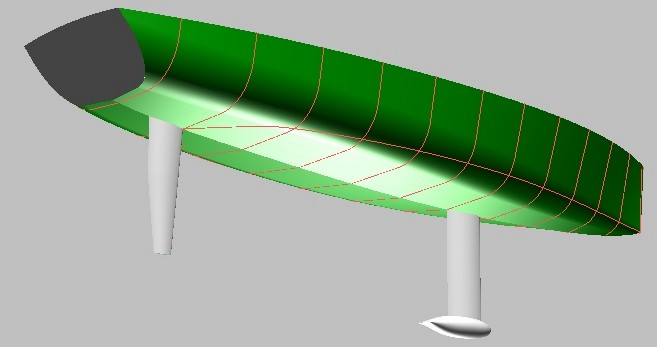
3D rendering of radius chine plywood underbody
This boat is intended for classic sailboat racing, so it needed a classic appearance. To this end we have:-
1) Extended the aft end into a counter stern. This will weigh a bit more but it extends the sailing length, for higher speed potential in stronger conditions.
2) Cropped the forward end to form a plumb bow.
3) Added bulwarks, both because it is a classic feature and to add spring to the sheer. The bulwarks are 100mm high in the bow and taper to a normal toerail height aft of the cabin, so that crew can sit comfortably on the rail.
4) Changed the cabin shape to a more traditional profile with almost vertical sides and compound curved roof.

3D Rendering of topsides and deck
5) Replaced the modern fractional rig with a big gaff cutter rig. It has carbon spars to reduce rig weight and increase stability. It is very versatile, allowing a wide selection of sail options, to really pile on sail area in the light stuff and reef it right down to a compact fully inboard gaff sloop rig in strong winds, and many variations between. The bowsprit pivots around the bow and retracts to stow on the sidedeck. The Genoa, Yankee and asymmetrical spinnaker are tacked to the bowsprit, so they can be pivoted up to windward for deeper sailing angles instead of being stuck on centreline.

Versatile gaff cutter rig?
These changes have morphed a very fast modern little racer/cruiser into a traditional racer/cruiser that will be capable of even higher speeds than the original design. It should be extremely quick in light winds and downwind in stronger conditions. The rig is a direct development of the rigs used on the Cape Cutter 19 and Cape Henry 21. Both are surprisingly quick little cruisers in the light to moderate breezes because of their large sail plans, yet are very capable in stronger conditions as well. However, they don't have planing underbodies and the Didi 29 Retro has inherited the planing underbody of the Didi 26, so should go like a witch downwind.
The standard keel options are lifting or fixed bulb keels. The rudder is a cassette that drops through the cockpit floor and locks in place for sailing but can be lifted out for trailing or access to shallow moorings.
The first boat will be built in Hout Bay, South Africa, by the owner. He will use a pre-cut kit of all plywood components, which will be supplied by CKD Boats . Builders will have the choice of building from plans only, plans with full-size Mylar bulkhead patterns or plans with a plywood kit.
For information on our other designs, please visit http://dixdesign.com/ .
Friday, April 13, 2012
Ost Power 20 - An International Effort
The Ost Power 20 is a new powerboat design that was commissioned by Ost Yachts of Moscow, Russia. The design brief was for a production GRP boat of very modern "stealth" styling and which could be economically shipped internationally in containers. The first boat was introduced at the Moscow Boat Show last month and will be doing demos in the Moscow area throughout the summer.

.JPG)
Ost Yachts plan to show their boats on boat shows in Europe. Visit the Ost Yachts Website.
Visit http://dixdesign.com/ for more inforamtion on all of our designs.
Read More..

Ost Power 20 on the Moscow Boat Show
This project turned into a true international effort, with multiple countries involved. I am a South African designer working in USA for a Russia client. The hull and deck plugs were made on a 5-axis router in Virginia, USA and were shipped to China. There the plugs were brought up to final finish and moulds were taken from them. The hull and deck components are moulded in China, with all stiffening added in the moulds. Then they are nested inside 40ft containers and shipped to the builder in Moscow, Russia. In Moscow they are assembled and all joinery and hardware added to complete them for sale into the Russian market. The first boat taken from the moulds underwent some testing in China.
.JPG)
The first boat testing in China
Ost Yachts plan to show their boats on boat shows in Europe. Visit the Ost Yachts Website.
Visit http://dixdesign.com/ for more inforamtion on all of our designs.
Tuesday, April 10, 2012
WOOD Regatta
It is time for the WOOD Regatta again and I encourage anyone with a small to moderate size wooden boat to join us for a weekend of fun. If you are on the US Mid-Atlantic Coast or nearby, it is well worth the effort to be there.
This is a weekend of racing but the emphasis is on fun rather than proving that you are Olympic medal material. Everybody there is a lover of wooden boats, especially the particular one that they will be sailing. Many of them have been lovingly restored or have been built by their owners, so they have little interest in enforcing their rights at marks or on the start line by bashing you out of the way. You need a working knowledge of the racing rules to be competitive but, if you are short of experience in that department, hang back from the fray to be safe.
Venue for the event is Rock Hall Yacht Club, on the Delmarva Peninsula, on the East side of Chesapeake Bay. The on-site facilities are good, with a club restaurant and plenty of space for camping in very pleasant surroundings. The club also has a swimming pool and rolling lawns for family to relax while you are sailing.

I will be there with my Paper Jet #1 and invite any other Paper Jet owners on the East Coast to join me there. Argie 15s would also be great boats to sail in this regatta, so please join us there. Last year there were entries from as far away as Massachusetts and Maine. I think that there was also someone who drove from Michigan.
Go to http://www.woodenboat.com/woodregatta.php to read more info and to download Notice of Race and application forms. Deadline for entry is 5th May, so put this on your "to do" list for action this month.

Read More..
This is a weekend of racing but the emphasis is on fun rather than proving that you are Olympic medal material. Everybody there is a lover of wooden boats, especially the particular one that they will be sailing. Many of them have been lovingly restored or have been built by their owners, so they have little interest in enforcing their rights at marks or on the start line by bashing you out of the way. You need a working knowledge of the racing rules to be competitive but, if you are short of experience in that department, hang back from the fray to be safe.
Venue for the event is Rock Hall Yacht Club, on the Delmarva Peninsula, on the East side of Chesapeake Bay. The on-site facilities are good, with a club restaurant and plenty of space for camping in very pleasant surroundings. The club also has a swimming pool and rolling lawns for family to relax while you are sailing.

View of the sailing waters from Rock Hall Yacht Club.
I will be there with my Paper Jet #1 and invite any other Paper Jet owners on the East Coast to join me there. Argie 15s would also be great boats to sail in this regatta, so please join us there. Last year there were entries from as far away as Massachusetts and Maine. I think that there was also someone who drove from Michigan.
Go to http://www.woodenboat.com/woodregatta.php to read more info and to download Notice of Race and application forms. Deadline for entry is 5th May, so put this on your "to do" list for action this month.

Rock Hall Yacht Club from the dinghy beach. Camping is along the tree line to the right of the club house.
Subscribe to:
Posts (Atom)
