Saturday, November 23, 2013
Time to Order for Winter Projects
The weather is getting colder in the north and our minds move to thoughts of staying inside to keep warm. Staving off cabin fever from being trapped inside becomes a problem, particularly if you have children. Keeping them interested and active can become a problem as the cold months go by.
Building a small boat in your workshop or basement can do wonders in this situation,. It draws the young ones away from computer games and cell phones, teaching them new skills that they can use throughout their lives. They will be helping to create something with character, something that would not have existed without their work, which will give them a lot of fun in the warmer months and which they will appreciate more and look after better because they helped to create it with their own hands. We all take more care of things if we had a big hand in creating them.
We have designs that are well-suited to building in small and cozy spaces. Some of these boats have been built in bedrooms or dining rooms, even apartments or basements that have only standard doors through which to remove them when completed. They can be built with basic hand tools; you don't need a well-outfitted workshop nor to be a woodworking craftsman to produce a small boat of which you can be proud.
The plans to kick off a project like this make a good Christmas present, whether for a husband or one of the children. If this is your plan, please order soon to ensure that you have the package before Christmas. We will soon be closed for a few weeks and will not be able to supply from 10th December through to 14th January.
To see our full range of designs, please go to http://dixdesign.com/ and our pricelist.
Read More..
Building a small boat in your workshop or basement can do wonders in this situation,. It draws the young ones away from computer games and cell phones, teaching them new skills that they can use throughout their lives. They will be helping to create something with character, something that would not have existed without their work, which will give them a lot of fun in the warmer months and which they will appreciate more and look after better because they helped to create it with their own hands. We all take more care of things if we had a big hand in creating them.
 |
| Argie 10 built by 2 young brothers while Dad was away |
 |
| Louis de Lassus built his Argie 15 in his Paris basement |
To see our full range of designs, please go to http://dixdesign.com/ and our pricelist.

Monday, November 18, 2013
Didi Sport 15 - A Family Boat with Juice
Some of my supporters have been waiting for this boat for a long time. I have posted sneak previews of the Didi Sport 15 (or DS15) but the design was taking its time to reach completion. It was leap-frogged in the design queue by designs that were much more demanding of my time.
Now the plans are complete aside from some minor details and the prototype is into the final stages of build. This boat is looking very good, with interesting finishes and excellent standard of finish. The builder is creating a work of art of which he will be justifiably very proud.
This design, like the Didi 950 that I introduced last week, is a development from the Didi Mini Mk3. It has a modern hull shape with topside chine aft, built from plywood.
The concept of the DS15 is a boat that can be stable and safe for family sailing and raid type racing, exciting as a little ballasted sportboat and super-fast as an unballasted trapeze dinghy. Choose your style of sailing or switch back-and-forth depending on conditions or who will be sailing with you.
The rig combines a reefable square-top mainsail with self-tacking jib, as working sails, with an asymmetrical spinnaker on retracting bowsprit to supercharge it downwind. It also has a light drifter/reacher Genoa for light airs when your wife is aboard and doesn't want the excitement of the asymmetrical.
It can be built by amateur or professional builders, from plans and offsets, from plans and full-size Mylar patterns or from plans and a CNC plywood kit. Go to our pricelist to order plans or plans and patterns. Go to our USA kits page to order a kit of all plywood components, accurately cut by CNC router.
Please visit our website at http://dixdesign.com/ for more info on this and our other designs.
Read More..
Now the plans are complete aside from some minor details and the prototype is into the final stages of build. This boat is looking very good, with interesting finishes and excellent standard of finish. The builder is creating a work of art of which he will be justifiably very proud.
This design, like the Didi 950 that I introduced last week, is a development from the Didi Mini Mk3. It has a modern hull shape with topside chine aft, built from plywood.
 |
| Didi Sport 15 hull, radius chine with topside chine. |
 |
| Didi Sport 15 rig |
 | ||
Didi Sport 15 Prototype, round bilge from plywood.
|

Please visit our website at http://dixdesign.com/ for more info on this and our other designs.
Tuesday, November 12, 2013
Kits for our Plywood Boats
Kits for our plywood boats have been available in USA for more than 10 years. This has had mixed success, depending on who was cutting the kits. Following on the sale of the company that had the rights to cut our kits, the quality of service deteriorated to a level that was no longer tolerable, so I rescinded the cutting rights. That brought us to the current arrangement of marketing the kits ourselves and sub-contracting the cutting to Chesapeake Light Craft in Annapolis.
This has worked out very well. The quality of the kits supplied to date has been excellent and the shipping has been both economically priced and efficient. They have cut numerous dinghy kits, including the Dixi Dinghy and the Paper Jet.
The are currently preparing to cut a large kit, comprising 61 sheets of plywood, for a Didi 950 that will be shipped to a builder in Ohio. This is a radius chine plywood boat with topside chine that is designed to the Class 950 Rule and makes a very nice fast cruiser, in addition to its primary racing purpose.
We have also sent them an order for a smaller but nevertheless substantial kit. This is for a Didi 29 Retro that will be shipped to a builder in North Carolina.This is also a radius chine plywood boat but without the topside chine. It is a development, in classic image, from our popular Didi 26 trailer-sailer design and will be rigged with the cruising rig option of the two gaff rigs that we supply with the design.
I have reworked the panel files for these large kits so that all parts that are larger than a sheet of plywood are jointed with jigsaw joints. These joints are easy to assemble and produce very accurate panels. Click to read about jigsaw joints.
The range of plywood kits that we can offer in USA is expanding fast. Click to see the full list. If there is a plywood design for which you want a kit, please email Dudley and ask for a price. It may take a week or two to rework the panel files to suit the Chesapeake Light Craft format then get a price for the kit but we will get that info to you as speedily as we can.
If you are outside of the USA, you can still order one of our kits from our suppliers in other countries .
To see our full range of boat designs, please visit http://dixdesign.com/
Read More..
This has worked out very well. The quality of the kits supplied to date has been excellent and the shipping has been both economically priced and efficient. They have cut numerous dinghy kits, including the Dixi Dinghy and the Paper Jet.
 |
| Plywood Dixi Dinghy, fun little 3:1 dinghy to row/motor/sail. |
 |
| 3D image of radius chine plywood Didi 950 |
 | |
| 3D image of radius chine plywood Didi 29 Retro |
The range of plywood kits that we can offer in USA is expanding fast. Click to see the full list. If there is a plywood design for which you want a kit, please email Dudley and ask for a price. It may take a week or two to rework the panel files to suit the Chesapeake Light Craft format then get a price for the kit but we will get that info to you as speedily as we can.
If you are outside of the USA, you can still order one of our kits from our suppliers in other countries .
To see our full range of boat designs, please visit http://dixdesign.com/
Sunday, November 3, 2013
Racing to Rio - A perspective on Crossing the South Atlantic Ocean
I have crossed the South Atlantic under sail four times. Three times it was with full crew from Cape Town, South Africa, to Rio de Janeiro, Brazil, in the Cape to Rio Race. The other crossing was double-handed and going the other way. I will do it again in January but this time the build-up is proving to be very different.
First, I am not there to prepare the boat for the race myself. I have always been there to take charge of the preparations, with much able assistance from my crew and my family. This time I must rely on someone else to sort out any issues and to ready "Black Cat" for her 3,250 nautical mile voyage. That distance is nearly 3800 land miles and more than 50% longer than the famed Trans-Pac Race.
This voyage is small compared with a round-the-world voyage but it is, nevertheless, a major voyage and it is across waters that see very little traffic. Aside from commercial fishing ships and the boats that are racing, there are very few vessels crossing this ocean at any time. We have to be self-sufficient, to take care of whatever situation fate and the weather gods might send our way. We can't make a VHF call to the Coast Guard or US Towing to come fetch us. Each boat has to rely on its crew in an emergency and vice-versa; boat and crew are totally inter-dependent and both have to be fully prepared. And, in the traditions of all seafarers, all boats are ready and willing to assist each other if needed.
I am very grateful for the work that is being done in Cape Town by Dave Immelman in preparing "Black Cat" in my absence. Dave will be my navigator for this race and was her skipper for the 1,800 mile Governor's Cup Race from Simonstown to St Helena Island in December last year. He is the only one on the crew who lives in the Cape, so a big load has fallen on his shoulders ahead of this race. The Cat is now 18 years old and Dave has been charged with upgrading anything that needed upgrading, from structure through to finishes, rig, systems, equipment and sails. In many respects the St Helena Race served as a good shake-down to highlight any issues that have developed in the years since I handed her over to her current owner, Adrian Pearson. I look forward to test-sailing her on Table Bay with all the new goodies that she has gained since I last sailed on her.
The other difference is that for previous races I lived in Cape Town and this time I live in USA. In Cape Town I was always surrounded by people from the sailing community. Cape Town is a beautiful place to sail, one of the best in the world. It can also be one of the toughest places in the world to sail, with sometimes violent weather and extremely testing seas. In that environment the fact that I was soon to cross an ocean on a small boat was of passing interesting but not considered to be too much out of the ordinary. After all, if you can sail in Cape Town you can sail anywhere, so what could be special about an ocean crossing?
This time it is very different. My neighbours know that I design boats for a living. They have not seen the big boats that I have built, only the little Paper Jet that took shape in their neighbourhood and drags around faithfully behind my minivan when I am going sailing. They have not seen the boisterous to wild conditions in which so much of the Cape Town racing happens. Here I am a bit of an oddity because I just don't fit into the mould. They are very supportive of what I am doing but don't really comprehend it; the who, where, what and how of sailing across an ocean. I must admit that I do enjoy explaining to them what I will be doing, where we will sail, the beauty of Cape Town and Rio, the good and bad experiences of sailing a small boat across thousands of miles of open water, through good weather and bad and the real or imagined dangers. In their view I fit in somewhere between eccentric and totally crazy, leaning mostly toward the crazy end of the scale. They worry mostly that it is a very dangerous thing to do.
The truth of a voyage is really somewhere between how it is viewed by my friends in Cape Town and those here in Virginia Beach. In each of the races that I have sailed we have had to cope with at least one big storm and another one or two smaller ones. Yes, it is dangerous; but we do what we can to reduce the danger. As far as I can recall, only one person has died during the Cape to Rio Race in the 42 year history of the event. Thousands have participated, two boats have sunk on the race, two have sunk on the return voyage and only one person has died. That was from a heart attack that would likely have happened on land anyway.
We all take precautions because it is dangerous to be on a small boat way out of sight of land. The boats are all fully equipped with a wide range of safety equipment, which has to be maintained according to mandated schedules. All boats are scrutinied before being allowed to start. All boats have to prove a high level of experience and/or certification among the crew before they are accepted. That experience and certification is for ocean experience, navigational and seamanship skills and the ability to take care of medical emergencies with the very comprehensive medical kit that we carry with us.
Additional to those documented requirements, every skipper sets his/her own standards for behavior on their particular boat. I can't vouch for other skippers but on "Black Cat" we go into safety mode in bad weather and from dusk to dawn, when no person is allowed on deck without first putting on their safety harness and clipping onto one of the many secure points on deck before exiting the interior of the boat. Along with this, a clear head is always required, 24/7, so there is no drinking of alcohol except for one optional drink at happy hour each day. There will be plenty of time to imbibe in Brazil.
An ocean crossing like this does not need to be dreaded but neither is it a cakewalk. We need exciting activities in our lives to build the memories that we cherish. They help to remind us that we are alive and have a purpose in our lives, they give us the material with which to tell the stories that will entertain our friends and grandchildren in the autumn years to come. If we don't reach those autumn years we still come out ahead because we have had a lot of fun and excitement along the way.
Read More..
First, I am not there to prepare the boat for the race myself. I have always been there to take charge of the preparations, with much able assistance from my crew and my family. This time I must rely on someone else to sort out any issues and to ready "Black Cat" for her 3,250 nautical mile voyage. That distance is nearly 3800 land miles and more than 50% longer than the famed Trans-Pac Race.
This voyage is small compared with a round-the-world voyage but it is, nevertheless, a major voyage and it is across waters that see very little traffic. Aside from commercial fishing ships and the boats that are racing, there are very few vessels crossing this ocean at any time. We have to be self-sufficient, to take care of whatever situation fate and the weather gods might send our way. We can't make a VHF call to the Coast Guard or US Towing to come fetch us. Each boat has to rely on its crew in an emergency and vice-versa; boat and crew are totally inter-dependent and both have to be fully prepared. And, in the traditions of all seafarers, all boats are ready and willing to assist each other if needed.
I am very grateful for the work that is being done in Cape Town by Dave Immelman in preparing "Black Cat" in my absence. Dave will be my navigator for this race and was her skipper for the 1,800 mile Governor's Cup Race from Simonstown to St Helena Island in December last year. He is the only one on the crew who lives in the Cape, so a big load has fallen on his shoulders ahead of this race. The Cat is now 18 years old and Dave has been charged with upgrading anything that needed upgrading, from structure through to finishes, rig, systems, equipment and sails. In many respects the St Helena Race served as a good shake-down to highlight any issues that have developed in the years since I handed her over to her current owner, Adrian Pearson. I look forward to test-sailing her on Table Bay with all the new goodies that she has gained since I last sailed on her.
 |
| Racing under spinnaker into inky darkness. Sean Collins & Adrian Pearson in the cockpit. |
This time it is very different. My neighbours know that I design boats for a living. They have not seen the big boats that I have built, only the little Paper Jet that took shape in their neighbourhood and drags around faithfully behind my minivan when I am going sailing. They have not seen the boisterous to wild conditions in which so much of the Cape Town racing happens. Here I am a bit of an oddity because I just don't fit into the mould. They are very supportive of what I am doing but don't really comprehend it; the who, where, what and how of sailing across an ocean. I must admit that I do enjoy explaining to them what I will be doing, where we will sail, the beauty of Cape Town and Rio, the good and bad experiences of sailing a small boat across thousands of miles of open water, through good weather and bad and the real or imagined dangers. In their view I fit in somewhere between eccentric and totally crazy, leaning mostly toward the crazy end of the scale. They worry mostly that it is a very dangerous thing to do.
The truth of a voyage is really somewhere between how it is viewed by my friends in Cape Town and those here in Virginia Beach. In each of the races that I have sailed we have had to cope with at least one big storm and another one or two smaller ones. Yes, it is dangerous; but we do what we can to reduce the danger. As far as I can recall, only one person has died during the Cape to Rio Race in the 42 year history of the event. Thousands have participated, two boats have sunk on the race, two have sunk on the return voyage and only one person has died. That was from a heart attack that would likely have happened on land anyway.
 |
| Gavin Muller repairing sails during the 1996 race. |
We all take precautions because it is dangerous to be on a small boat way out of sight of land. The boats are all fully equipped with a wide range of safety equipment, which has to be maintained according to mandated schedules. All boats are scrutinied before being allowed to start. All boats have to prove a high level of experience and/or certification among the crew before they are accepted. That experience and certification is for ocean experience, navigational and seamanship skills and the ability to take care of medical emergencies with the very comprehensive medical kit that we carry with us.
Additional to those documented requirements, every skipper sets his/her own standards for behavior on their particular boat. I can't vouch for other skippers but on "Black Cat" we go into safety mode in bad weather and from dusk to dawn, when no person is allowed on deck without first putting on their safety harness and clipping onto one of the many secure points on deck before exiting the interior of the boat. Along with this, a clear head is always required, 24/7, so there is no drinking of alcohol except for one optional drink at happy hour each day. There will be plenty of time to imbibe in Brazil.
An ocean crossing like this does not need to be dreaded but neither is it a cakewalk. We need exciting activities in our lives to build the memories that we cherish. They help to remind us that we are alive and have a purpose in our lives, they give us the material with which to tell the stories that will entertain our friends and grandchildren in the autumn years to come. If we don't reach those autumn years we still come out ahead because we have had a lot of fun and excitement along the way.
Wednesday, October 30, 2013
Anthony Steward - Around Alone in an Open Boat
More than 20 years ago Anthony Steward sailed around the world on a tiny open boat. He took the mould plug from my TLC 19 trailer-sailer and turned it into a boat to circum-navigate the world. Nobody had done it before him and nobody has done it since.
Anthony has always been very modest about his achievement and has done very little to publicise it. Most of the publicity that it has received has been through articles that I have written for magazines, the article on my website and his chapter in my book "Shaped by Wind & Wave".
I am pleased to see that this has now changed. A video that was made 20 years ago, documenting his voyage, is now on YouTube. It is worth the 30 minutes to watch it, to understand just how tough this voyage was.
Anthony modified my little boat extensively to serve the purpose that he needed. We have many designs to take you more comfortably around the world or just to take you across your local pond. Please visit http://dixdesign.com/.
Read More..
 |
| Ant Steward's little boat shipwrecked in the Seychelles |
I am pleased to see that this has now changed. A video that was made 20 years ago, documenting his voyage, is now on YouTube. It is worth the 30 minutes to watch it, to understand just how tough this voyage was.
Anthony modified my little boat extensively to serve the purpose that he needed. We have many designs to take you more comfortably around the world or just to take you across your local pond. Please visit http://dixdesign.com/.
Monday, October 28, 2013
Wrap-up of Georgetown Wooden Boat Show
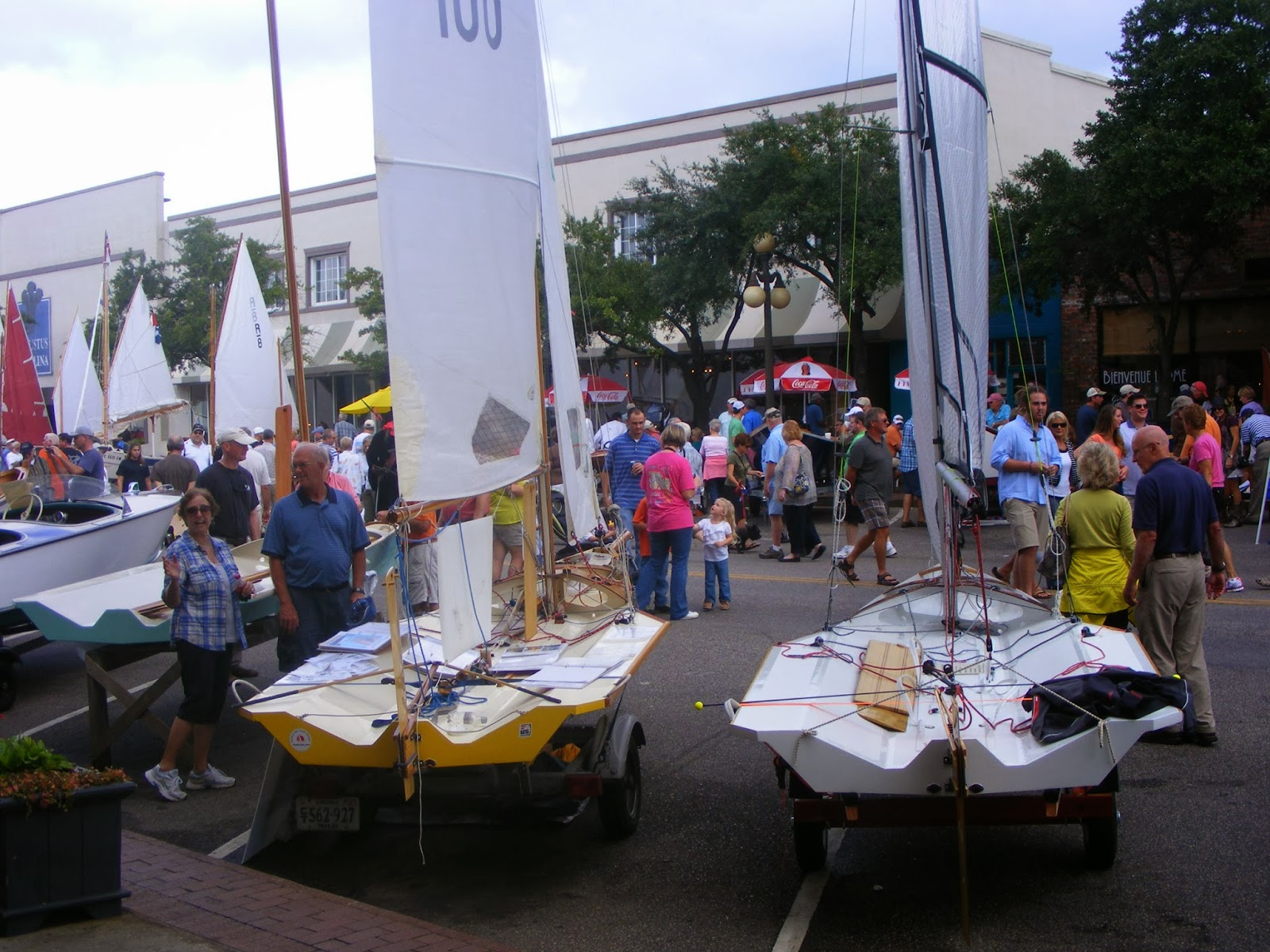
Last weekend we exhibited our Paper Jet on the Georgetown Wooden Boat Show in South Carolina. This was our 2nd time at this show, having been there in 2009 and won a special award for our Paper Jet. This time she wasn't lonely and was in the company of two sisters from the area. The show was on Saturday 19th October, on the Georgetown waterfront.
In the photo above, the yellow boat in the middle is my prototype, which you have probably seen many times before. The turquoise boat on the right belongs to Ted Bullock of Barrier Island Boatbuilders in Charleston. His boat is not yet complete and was displayed with the mast free-standing and no sails. The white boat in the background belongs to Bob Turner of Pawleys Island and was completed the week before the show, with the mainsail being set for the first time at the show.
Bob's Mylar sails were supplied by i-Sails . My sails are Dacron and supplied by Baxter Sails but they also offer them in Mylar. For those who are interested, you can compare the two sails in the photos. Mine is a fathead sail shaped to my original design. Bob's Mylar sail is a more modern squaretop sail to the i-Sails design that is being used in Europe. It has a marginally wider head and considerably less roach.
It will be interesting to compare the efficiency of the two sails when we can sail against each other. We intended to do that the evening before the show but heavy rain washed that plan away.


As always, my good wife, Dehlia, was at the show with me. Over the years she has become very competent and knowledgeable of our designs. She is a big help to me for talking to existing and potential builders of our boats and only has to refer the more technical questions to me.
We had a good flow of visitors all day. We were pleased to be visited by a few people who are already building our boats, including one who is building the Didi 29 Retro with cruising rig in North Carolina. Thanks to all who came to chat, we will be back again in a few years.
To see our full range of designs, please visit http://dixdesign.com/.
Read More..
 |
| Three Paper Jets at Georgetown Wooden Boat Show |
Bob's Mylar sails were supplied by i-Sails . My sails are Dacron and supplied by Baxter Sails but they also offer them in Mylar. For those who are interested, you can compare the two sails in the photos. Mine is a fathead sail shaped to my original design. Bob's Mylar sail is a more modern squaretop sail to the i-Sails design that is being used in Europe. It has a marginally wider head and considerably less roach.
It will be interesting to compare the efficiency of the two sails when we can sail against each other. We intended to do that the evening before the show but heavy rain washed that plan away.


As always, my good wife, Dehlia, was at the show with me. Over the years she has become very competent and knowledgeable of our designs. She is a big help to me for talking to existing and potential builders of our boats and only has to refer the more technical questions to me.
 |
| Dehlia chatting to a visitor at the show. |
To see our full range of designs, please visit http://dixdesign.com/.
Wednesday, October 23, 2013
Radius Chine Plywood Class 950
The Didi 950 is our newest design and the plans are now nearing completion. They show a very modern boat that is designed to comply with the Class 950 Rules and which can be built by any reasonably competent amateur woodworker.
The Class 950 Rule produces a fast boat that is great for level boat-for-boat racing. The rule results in reasonable proportions and features, for a safe and strong boat with comfortable accommodation that is also good for a performance cruiser.
Construction is radius chine plywood with a hard chine aft in the topsides. This format produces a very modern hull that is built mostly from a very low-tech sheet material, yet looks as good as any moulded composite boat that can only be built with skills that most amateurs don't have. Most men are comfortable working with wood and this construction method allows them to use those skills to build a competitive boat.
The more that I look at this boat the more that I would like to be on it for offshore or ocean racing. This would be a great boat for sailing trans-Atlantic in the Cape to Rio Race or going across the Pacific in the Trans-Pac Race. Close-reaching to broad-reaching under asymmetrical and powered up by water ballast tanks, she will be a thrilling boat, reeling off the miles like few others in this size range can do.
Someone close by, please build one of these boats. I need to sail on this one.
For more info go to http://dixdesign.com/didi950.htm and visit our website at http://dixdesign.com/ to see our other designs.
Read More..
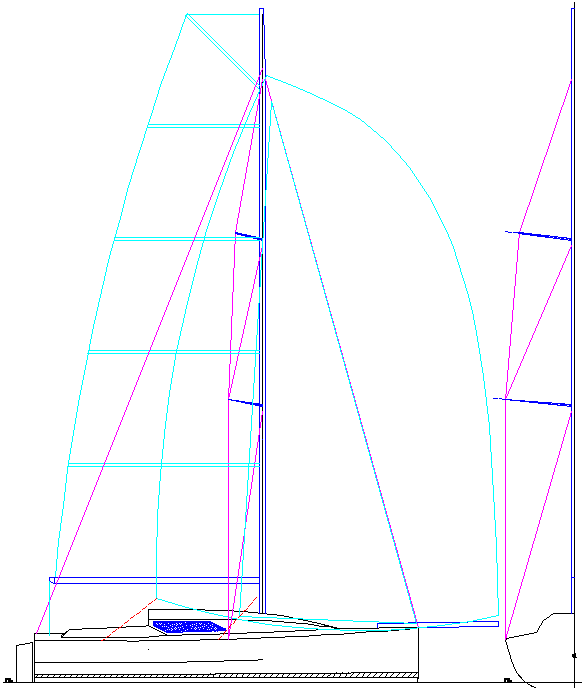 |
| Sail plan of Didi 950 |
 |
| Class 950 accommodation |
 |
| 3D Profile of Didi 950 |
 |
| 3D View with contours to highlight hull shape. |
For more info go to http://dixdesign.com/didi950.htm and visit our website at http://dixdesign.com/ to see our other designs.
Subscribe to:
Posts (Atom)
